- Flipped Classroomslcsd Educational Technology Resources Internships
- Flipped Classroomslcsd Educational Technology Resources Definition
Flip Tip: Store on-demand flipped classroom videos in a video management system then copy and paste embed code for your videos into your LMS. Students can easily find and watch their asynchronous learning resources in the same place they go for all course-related communication and content — simply by pressing play.
In my book, too, I talk about how in the early 2000's, flipped learning emerged from three different sources in higher education almost all at the same time (with two of those sources being universities 40 miles apart from each other), and then re-emerged in the 2010's in the K-12 world, all mostly unaware of each others' existence. Video clips, educational games, and virtual simulations are just a few examples of technology resources you can use to engage and educate in the classroom. Plus, the vast majority of today’s careers require at least some digital skills (which include anything from complex skills like coding to simpler ones like composing and sending emails). The flipped classroom is a useful technique that has moved lectures out of the class, and onto digital media. In doing so, teachers can drastically increase interaction time with their students. It also creates two unique learning environments instead of just one, and opens up the opportunity for students to ask questions, solve problems,. Critics of flipped classrooms say it can be hard to get students on board and claim the model benefits students from families with more resources.
Journal of e-Learning and Knowledge SocietyVolume 12, Number 4, ISSN 1826-6223e-ISSN 1826-6223Publisher: Italian e-Learning Association
Abstract
This research focuses on the efficiency of the flipped classroom method and its effects on students’ achievement and cognitive load levels. The flipped classroom method is compared to traditional techniques in this study through quasi-experimental research. Participants included 116 prospective teachers assigned to experimental and control groups. The study was conducted over 10 weeks during the 2013–2014 spring semester. Results showed that students taught with the flipped classroom model reported higher learning achievements and lower cognitive loads than those taught with the traditional model. The instructional efficiency scores of the students in the experimental group were also higher than those of the students in the control group. Hence, when designed effectively, the flipped classroom method can be considered a useful approach in higher education settings.
Citation
Turan, Z. & Goktas, Y. (2016). The Flipped Classroom: instructional efficency and impact of achievement and cognitive load levels,. Journal of e-Learning and Knowledge Society, 12(4),. Italian e-Learning Association. Retrieved January 25, 2021 from https://www.learntechlib.org/p/173672/.
Keywords
References
View References & Citations Map- Ash, K. (2012). Educators view the “flipped” model with a more critical eye. Education Week, 32(2), S6–S7.
- Baepler, P., Walker, J.D., & Driessen, M. (2014), It’s not about seat time: Blending, flipping, and efficiency in active learning classrooms. Computers& Education, 78, 227–236.
- Bishop, J.L. (2013), A controlled study of the flipped classroom with numerical methods for engineers (Unpublished doctoral dissertation). Utah State University, Logan.
- Chin, C.A. (2014), Evaluation of a flipped classroom implementation of data communications course: Challenges, insights and suggestions. Retrieved from http://www.spsu.edu/cte/publications/publications2014/sotl_2014_chin.pdf Clark, K.R. (2013), Examining the effects of the flipped model of instruction on student engagement and performance in the secondary mathematics classroom:
- Clark, R.C., Nguyen, F., & Sweller, J. (2006), Efficiency in learning: Evidence-based guidelines to manage cognitive load. San Francisco, CA: Wiley.
- Howell, D. (2013), Effects of an inverted instructional delivery model on achievement of ninth-grade physical science honors students (Unpublished doctoral dissertation). Gardner-Webb University, Boiling Springs, NC.
- Johnson, L.W., & Renner, J.D. (2012), Effects of the flipped classroom model on a secondary computer applications course: Student and teacher perceptions, questions and student achievement (Unpublished doctoral dissertation). University of Louisville, KY.
- Kılıç, E., & Karadeniz, Ş. (2004), Specifying students’ cognitive load and disorientation level in hypermedia. Educational Administration Theory and Practice, 40(1), 562– 579.
- Lage, M., Platt, G., & Treglia, M. (2000), Inverting the classroom: A gateway to creating an inclusive learning environment. Journal of Economic Education, 31(1), 30–43.
- Marlowe, C. (2012), The effect of the flipped classroom on student achievement and stress (Unpublished master’s thesis). Montana State University, Bozeman.
- Mayer, R.E., & Moreno, R. (2003), Nine ways to reduce cognitive load in learning from multimedia. Educational Psychologist, 38, 43–52.
- McGivney-Burelle, J., & Xue, F. (2013), Flipping calculus. PRIMUS: Problems, Resources, and Issues in Mathematics Undergraduate Studies, 23(5), 447–486.
- O’Flaherty, J. & Philips, C. (2015), The use of flipped classrooms in higher education: A scoping review. Internet and Higher Education, 25, 85–95.
- Paas, F., & Van Merriënboer, J. (1993), The efficiency of instructional conditions: An approach to combine mental effort and performance measures. Human Factors: The Journal of the Human Factors and Ergonomics Society, 35(4), 737–743.
- Pierce, R., & Fox, J. (2012), Vodcasts and active-learning exercises in a “flipped classroom” model of a renal pharmacotherapy module. American Journal of Pharmaceutical Education, 76(10), 1–5.
- Pluta, W., Richards, B., & Mutnick, A. (2013), PBL and beyond: Trends in collaborative learning. Teaching and Learning in Medicine, 25(S1), S9–S16.
- Seery, M.K., & Donnelly, R. (2012), The implementation of pre-lecture resources to reduce in-class cognitive load: A case study for higher education chemistry. British Journal of Educational Technology, 43(4), 667–677.
- Stevens, J. (1996), Applied multivariate statistics for the social sciences (3rd ed.). Mahwah, NJ: Erlbaum.
- Street, S.E., Gilliland, K.O., McNeil, C., & Royal, K. (2015), The flipped classroom improved medical student performance and satisfaction in a pre-clinical physiology course. Medical Science Educator, 25(1), 35–43.
- Sweller, J. (1988), Cognitive load during problem solving: Effects on learning. Cognitive Science, 12(2), 257–285.
- Tabachnick, B.G., & Fidell, L.S. (2001), Using multivariate statistics (4th ed.). New York, NY: Allyn & Bacon.
- Tune, J.D., Sturek, M., & Basile, D.P. (2013, December), Flipped classroom model improves graduate student performance in cardiovascular, respiratory, and renal physiology. Advances in Physiology Education, 37(4), 316–320.
- Van Gerven, P., Paas, F., van Merriënboer, J., & Schmidt, H. (2002), Cognitive load theory and aging: Effects of worked examples on training efficiency. Learning and Instruction, 12(1), 87–105.
- Wilson, S.G. (2013), The flipped class: A method to address the challenges of an undergraduate statistics course. Teaching of Psychology, 40, 193–199.
Flipped Classroomslcsd Educational Technology Resources Internships
These references have been extracted automatically and may have some errors.Signed in users can suggest corrections to these mistakes.
Suggest Corrections to ReferencesCited By
View References & Citations MapEffects of ASQ-based flipped learning on nurse practitioner learners' nursing skills, learning achievement and learning perceptions
These links are based on references which have been extracted automatically and may have some errors.If you see a mistake, please contact info@learntechlib.org.
What is a flipped classroom?
Courses & CertificationFlipped Classroomslcsd Educational Technology Resources Definition
- Instructional Design Certificate (Fully Online). This fully online program is for anyone developing and/or teaching an online course. Learn more..
- ADDIE Instructional Design Certificate Program (Fully Online). This fully online program is designed for individuals interested in learning more about the ADDIE model. Learn more..
- Instructional Design Models Certificate (Fully Online). You will explore traditional instructional design models and the progression of the learning design approach to creating online learning experiences. Learn more..
A flipped classroom is an instructional strategy. “Flipping” a classroom entails switching up the usual model through which students encounter new knowledge. In a flipped classroom, students have required reading or lecture videos before the class meets, and then class time is used for discussions, problem-solving, or other kinds of active learning that will help them actualize and assimilate this new knowledge. To frame this model using Bloom’s revised taxonomy (2001), the “flipped” classroom has students undertake the lower levels of cognitive work (gaining knowledge) on their own beyond class time, and then has them focus on the higher levels of cognitive work (applications, analyses, evaluations, etc.) during class time, where they can take advantage of scaffolding support from peers and the instructor.

See also: How to create an online course
Here are some first steps for teachers considering “flipped” classrooms:
Step 1: Consider whether the “flipped” model makes sense for a particular course, taking the following questions into account:
- Do certain class sessions already have an in-class activity planned? Is this activity one that often takes time to complete, and that requires students to apply the knowledge or skills that they’ve just learned?
- Does the class involve concepts that students often struggle to understand, and often need the teacher’s help with? Based on past assignment grades, which concepts are these?
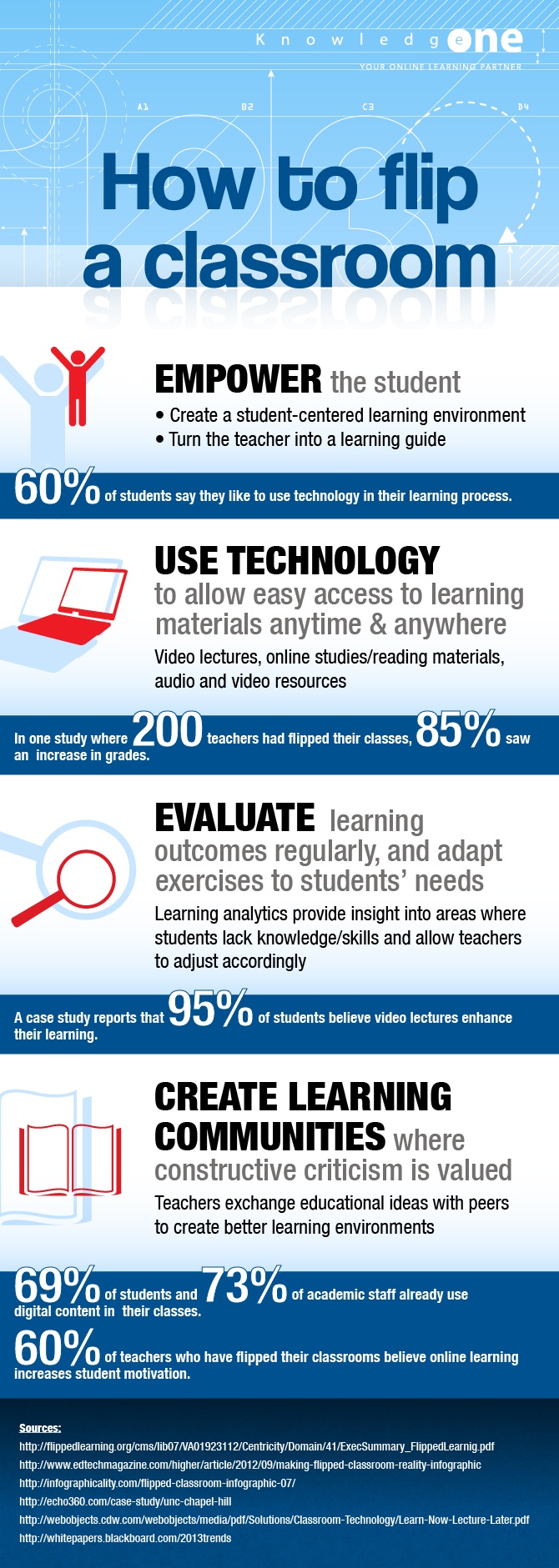
Step 2: Think about how students in a particular class or subject matter could benefit from engaging in applied learning that incorporates peer and instructor feedback. Here the most crucial issue is for teachers to consider how class meeting time could be used: students need to be engaged and challenged by the material, and the teacher’s own subject matter expertise should be put to use. There is no one best way to plan an active, collaborative learning experience – in the end, everything comes down to finding the approach that works best for a particular group of students learning particular course content! Here are a few approaches:
- Peer instruction
- Team based learning
- Problem based learning
- Inquiry based learning
- Case based learning
Step 3: Dynasty warriors pc games download. Spell out the connections between the different sides of the “flipped” model: what students gain “first exposure” to before class, and then the homework-like applications that then take place during class time.
Teachers can consider the following questions as they begin designing their own flipped classrooms:

- What should students be understanding and learning how to do, by completing this portion of the course?
- How do these learning activities fit into the larger overall picture of the course?
Which parts of a current homework assignment would be done better if students had practice and help applying its concepts? Are there any in-class learning activities that are being rushed for lack of time during class? - What kinds of practice do students need in order to successfully complete larger assignments on their own? Will students be able to make connections between the in-class activities and the larger assignment?
In this “flipped” model where students read or watch lectures before class and engage hands-on with concepts during class time, the work that students do after class is more flexible than it would be for the traditional model – teachers can decide how they think their particular students would best retain new knowledge. For instance, teachers can assign students to finish the activities they started during class time, to complete more challenging readings about the topic, to practice more on their own, or many other activities. (When planning, though, teachers should also bear in mind that students will be completing this after-class work at the same time as the lectures or reading to prepare for the next class session. Because of this overlap, managing workloads becomes especially important for a “flipped” classroom.)
Step 4: Adapt class materials so that students can acquire the course content ahead of class. Running a “flipped” classroom means that students must come to class prepared, since otherwise they can’t benefit from the day’s active learning, so teachers should consider their options for pre-class work carefully. Students may be asked to make use of one or more of the following options:
- Required readings (introductory chapters, applicable articles, etc.)
- Video and/or audio materials accessible online (recorded lectures, simulations, etc.)
A simple start is best, since students will be used to a traditional classroom model and may take time to get use to reading or lecturing first, and then homework-like activities during class time. Teachers should start out by using existing resources – their own, or reputable online content – instead of creating new materials from scratch. Teachers should also:
- Make sure students realize they are accountable for the pre-class readings or lectures
- Give students some way to ask questions about these reading or lectures, before the in-class activities
Step 5: Plan ways to extend the active learning experience beyond the classroom, either through individual work or additional collaborations. Think about how students’ new knowledge and skills from a “flipped” class can play into the larger design of the course – are they building on new concepts with each subsequent class, are they working on the pieces of a larger project, etc.? These questions become especially important since students may think they have gained mastery with the in-class work alone, which is rarely enough to meet all learning outcomes.
Teachers might consider one or more of the following options to help students reinforce their new knowledge and skills:

- Using online forums (discussion boards, social media, etc.) to continue discussions begun during class time
- Assigning additional problem sets or assessments to give students practice on their own. Such additional work can be made available on learning management systems (LMS) and graded online so that students get feedback quickly
- Creating smaller assignments that will require students to apply new knowledge and skills to different situations or in different contexts
- Encouraging the formation of informal learning groups where students can continue class discussions or collaborate on additional assignments
- Developing peer-led, in-person study sessions where students can also continue work or discussions that expand on class learning