Introduction
In Section 1.2, we learned about how the concept of limits can be used to study the trend of a function near a fixed input value. As we study such trends, we are fundamentally interested in knowing how well-behaved the function is at the given point, say (x = a). In this present section, we aim to expand our perspective and develop language and understanding to quantify how the function acts and how its value changes near a particular point. Beyond thinking about whether or not the function has a limit (L) at (x = a), we will also consider the value of the function (f (a)) and how this value is related to (lim_{x→a} f (x)), as well as whether or not the function has a derivative (f '(a)) at the point of interest. Throughout, we will build on and formalize ideas that we have encountered in several settings.

- This follows from the difference-quotient definition of the derivative. The last equality follows from the continuity of the derivatives at c. The limit in the conclusion is not indeterminate because. Lim x→0 sinx x!!!!!
- This calculus video tutorial provides a basic introduction into continuity and differentiability. Continuity tells you if the function f(x) is continuous.
3.7 Continuity And Differentiablityap Calculus Calculator

CALCULUS AB WORKSHEET ON CONTINUITY AND INTERMEDIATE VALUE THEOREM Work the following on notebook paper. On problems 1 – 4, sketch the graph of a function f that satisfies the stated conditions. F has a limit at x = 3, but it is not continuous at x = 3. F is not continuous at x = 3, but if its value at x = 3 is changed from f 31 to f 30.
We begin to consider these issues through the following preview activity that asks you to consider the graph of a function with a variety of interesting behaviors.
3.7 Continuity And Differentiablityap Calculus 14th Edition
3.7 Continuity And Differentiablityap Calculus Solver
Preview Activity (PageIndex{1})
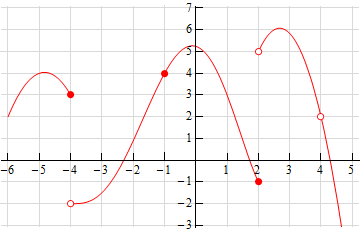
A function (f) defined on (−4 < x < 4) is given by the graph in Figure 1.7.1. Use the graph to answer each of the following questions. Note: to the right of (x = 2), the graph of (f) is exhibiting infinite oscillatory behavior similar to the function (sin( frac{π}{ x })) that we encountered in the key example early in Section 1.2.
(a) For each of the values (a) = −3, −2, −1, 0, 1, 2, 3, determine whether or not (lim_{x→a} f (x)) exists. If the function has a limit (L) at a given point, state the value of the limit using the notation (lim_{x→a} f (x)= L). If the function does not have a limit at a given point, write a sentence to explain why.
Figure (PageIndex{1}): The graph of (y = f (x)).
(b) For each of the values of a from part (a) where (f) has a limit, determine the value of (f (a)) at each such point. In addition, for each such a value, does (f (a)) have the same value as (lim_{x→a} f (x)) ?
What we know for sure is, no new business will get off the ground without a structured and robust marketing plan, and the five tips in this article will help ensure your business starts off on the right foot. No one should approach a new business thinking it will be a comfortable ride. 5 simple marketing tips to boost business in 2018. 5 Simple Marketing Tips to Boost Business in 2018 Dinah W. Brin. A freelance reporter and writer based in Philadelphia, Pa., Dinah previously worked as a staff reporter for The Associated Press and Dow Jones Newswires. Top 5 Marketing Planning Tips for 2018. The tools are simple to use (think Google and LinkedIn), powerful and can generate more options more quickly than traditional techniques, such.
3.7 Continuity And Differentiablityap Calculus Algebra
(c) For each of the values (a) = −3, −2, −1, 0, 1, 2, 3, determine whether or not (f '(a)) exists. In particular, based on the given graph, ask yourself if it is reasonable to say that f has a tangent line at ((a, f (a))) for each of the given (a)-values. If so, visually estimate the slope of the tangent line to find the value of (f '(a)).