
What is TGfU? Teaching Games for Understanding approach has caused considerable debate in game teaching for the last two decades The TGfU focuses upon teaching students tactical understanding before dealing with the performance of skills, as such the TGfU offers a tactical approach to games teaching emphasizing game performance before skill performance (Griffin, Mitchell, & Oslin, 1997). which allows the game performance to understand the tactical awareness, which leads to effective skill selection and skill execution.
- DEMONSTRATION OF TEACHING GAMES FOR UNDERSTANDING IN INVASION GAMES SUFFOLK ZONE APHERD 2014 SUFFOLK ZONE, NY NOVEMBER 4, 2014 Dr. Stephen Harvey West Virginia University, WV, USA 2. WHAT IS THE BIG IDEA? Development of Deep Understanding That can be transferred to other games.
- Teaching Games for Understanding (TGJIJ) approaches have made sigtiificant contributions to students' karning in invasion game contexts within a wide range of physical and sports education programs. In attempting to maximize team performance in invasion games, each pkyer and the team as a whole is confronted.
Invasion Games Teaching Games For Understanding People
A range of these approaches, including Teaching Games for Understanding, Game Sense, Play Practice and the Tactical-Decision Learning Model vary in detail but share enough in common to be referred.

The background to the TGfU approach is that it first started in the United Kingdom in the early 1980s. The ideas were spawned by Thorpe, Bunker, & Almond (1986) and drew on the earlier work of Mauldon & Redfern (1981). The reason why TGfU approach was proposed as an alternative to the technique approach because it was noted that techniques practiced in isolation did not transfer to the game. In addition Bunker & Thorpe (1986a) observed, and we believe this is still the same today, that the “games teaching shows at best, a series of highly structured lessons leaning heavily on the teaching of techniques, or at worst lessons which rely on the children themselves to sustain interest in the game.” The Teaching Games of understand approach was the best way to put the Why of a game before the How.
Skill acquisition and game play:
In tennis, becoming skilled is a gradual process that involves learning to implement the most appropriate movement pattern for situations that arise in game play. The problem that novice tennis players face is multifaceted; they need to learn which environmental cues are important and which are redundant in order to selectively attend to only the most essential information (Abernethy, 1987). Based on this information, the players need to select tactics during the game that will allow them the best opportunity to score a point, they also need to the coordinate patterns of movement that will have a effectively advantage over their opponent. specially tennis is a high moving sport which the players need to have a lot of tactics to beat their opponent.


Reference list
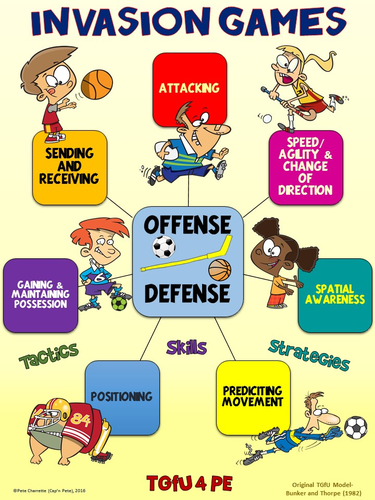
Invasion Games Teaching Games For Understanding Students
Griffin, L. L., Mitchell, S. A., & Oslin, J. L. (1997). Teaching sport concepts and skills:A tactical games approach. Champaign, IL: Human Kinetics.
Invasion Games Teaching Games For Understanding Strategies
Abernethy, B. (1987). Anticipation in sport: A review. Physical Education Review, 10(1),
5-16.

Bunker, D., & Thorpe, R. (1986a). Is there a need to reflect? In R. Thorpe, D. Bunker, & L. Almond (Eds.), Rethinking games teaching (pp. 25-34). Contactdiane jordan lcpc ncc mac lackey. Loughborough